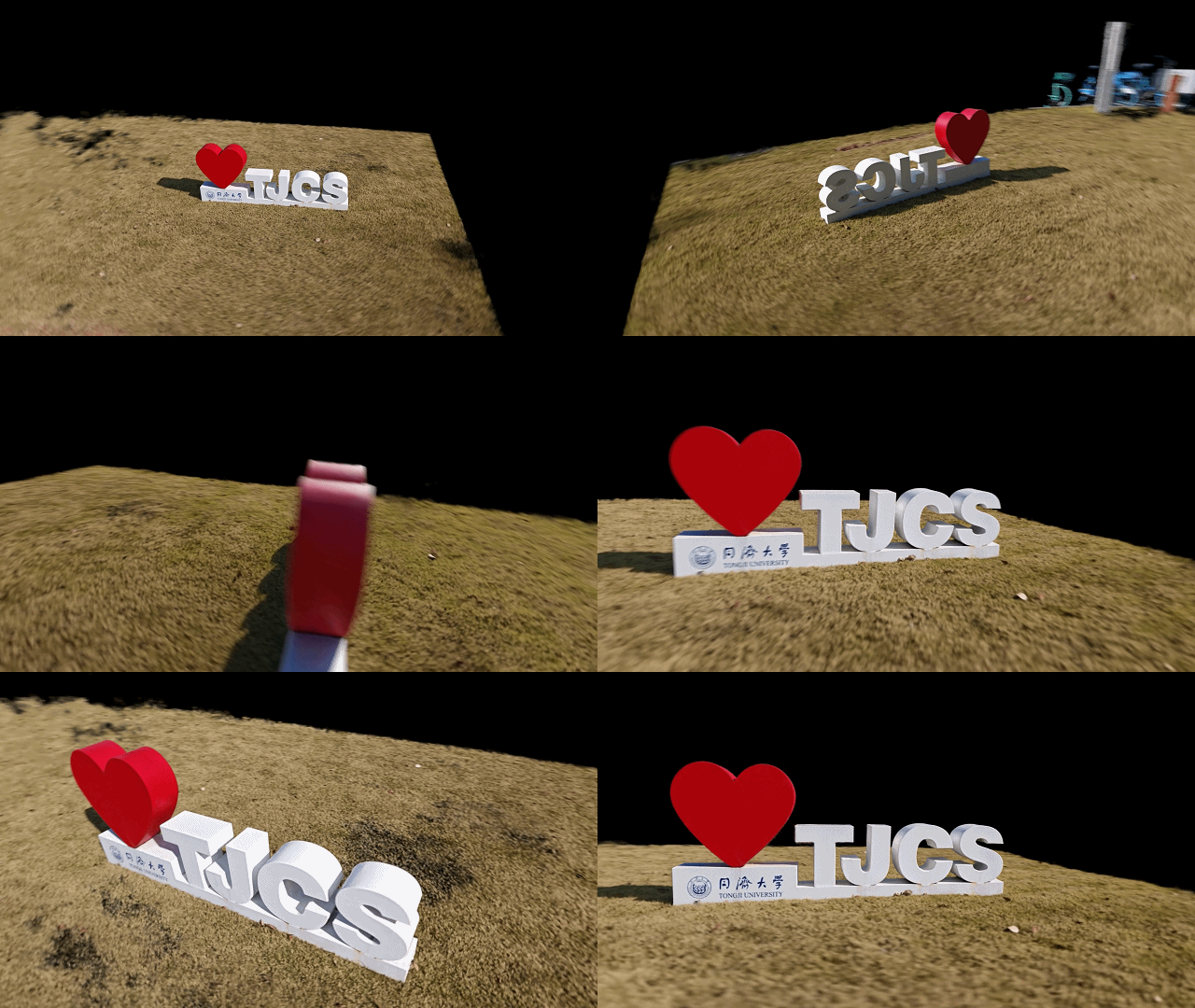
Instant-NGP
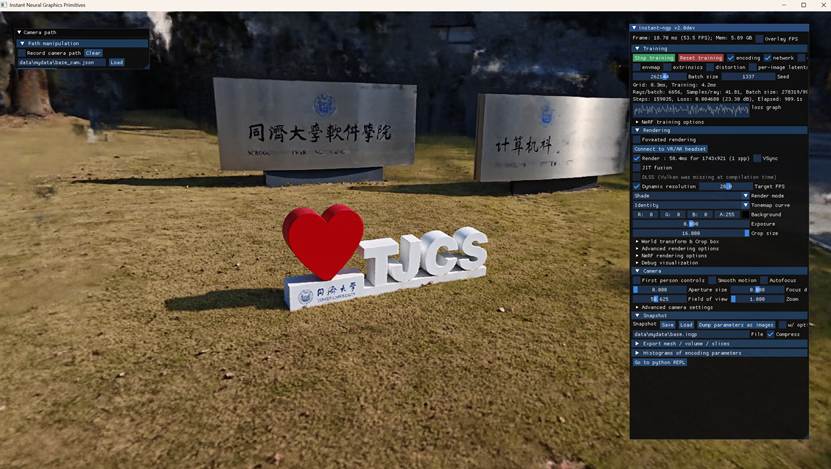
Instant-NGP
(Instant Neural Graphics Primitives) was proposed by Thomas Muller et al. from
Nvidia in 2022. The goal of this work is to significantly accelerate the
training and rendering speed of Neural Radiance Fields (NeRF) while maintaining
high-quality rendering results. Compared with the original NeRF, the most
innovative feature of Instant-NGP lies in the introduction of multi-resolution
hash tables: instead of using a single large Multi-Layer Perceptron (MLP)
network like the original NeRF, it partitions the 3D space into
multi-resolution grids, with each grid vertex storing learnable positional encoding
features. A hash table is used for compact storage of these features to avoid
video memory waste; when querying the color and opacity of a 3D point p,
interpolation is performed on the positional encoding features of grid vertices
at different resolutions associated with p to form the multi-scale
features of p, which can effectively enhance the detail expression
capability.
The
github repository of instant-ngp is https://github.com/NVlabs/instant-ngp/
In
this experiment, students are required to learn the use of Instant-NGP through
the following steps:
1) Capture a set of scene images;
2) Train a scene model using Instant-NGP;
3) Specify a rendering camera path and output the rendered video.
For
this assignment, only the rendered video as the following needs to be
submitted.